
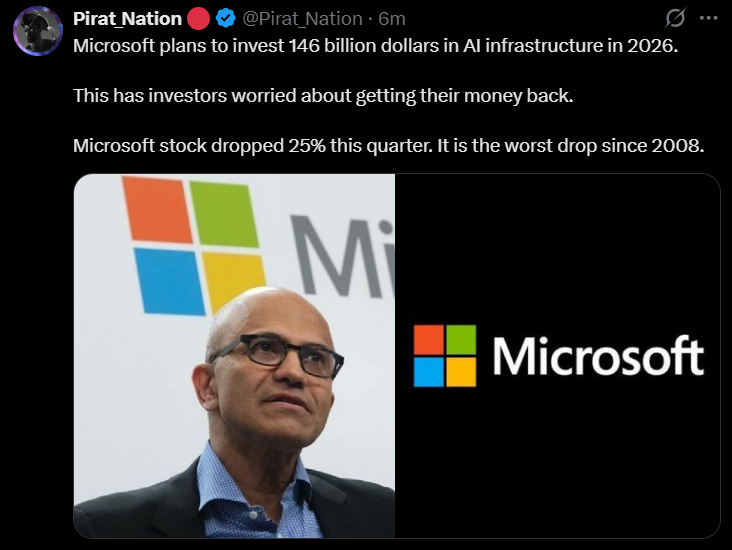
Microsoft Bets $146 Billion on AI Infrastructure in 2026:
Microsoft's AI investment in 2026 has reached a whopping $146 billion in planned capital expenditure, which is more than double the $88 billion it spent in fiscal 2025, and a 230% increase compared to just two years ago. In Q2 of fiscal year 2026, the company reported revenues of $81.3 billion, which is up 17% year-over-year, and operating income of $38.3 billion, which is up 21%. Its Azure cloud growth surged 39%, and its commercial remaining performance obligation (RPO), essentially future contracted revenue — hit an extraordinary $625 billion, which is up 110% year-over-year.
Microsoft Cloud revenue alone crossed $50 billion for the first time in a single quarter. Despite this growth, Microsoft stock has fallen approximately 25% in Q1 FY2026, making its worst quarterly performance since the 27% drop during the 2008 global financial crisis, which was nearly two decades ago.
In just one quarter, capital expenditures hit $37.5 billion, which is up 66% year-over-year, largely directed at building new AI data centers, securing power supplies, and ramping up the production of Microsoft's custom Maia AI chips. Microsoft CEO "Satya Nadella" stated, "We are only at the beginning phases of AI diffusion and already Microsoft has built an AI business that is larger than some of our biggest franchises."
It seems Microsoft's ambition is clear. It aims to be the dominant AI platform of the next decade, providing the cloud backbone — through Azure - on which the world's businesses will build, train, and deploy AI models. Microsoft Copilot, the company's flagship AI productivity suite, is now embedded across Word, Excel, PowerPoint, Outlook, and OneNote, and is already used by 90% of Fortune 500 companies in some capacity.
The company is also building "AI supercomputers," which are massive clusters of specialized "Nvidia H100" and "AMD MI300X" GPUs and custom silicon. They are building this to support not only its own services but also those of thousands of developers and enterprises through Azure.
Why Is Microsoft Stock Falling? Investors Are Worried:
The Microsoft stock decline in 2026 is a story of a company spending at a pace that has already outrun investor patience. "Wall Street" is no longer willing to grant tech giants an open-ended 'AI blank cheque.' As of late March 2026, Microsoft trades near the $374 mark, which is a roughly 21–25% drop year-to-date.
Microsoft's capital expenditure has risen over 40% annually for three consecutive years, with 2026 projections representing a 230% increase from just two years prior. In Q2 FY2026, the capital expenditure suddenly increased 66% to $37.5 billion, which is a figure that consumed a significant portion of the company's operating cash flow.
Analysts at several major investment banks estimate that at Microsoft's current AI revenue run rate of $13 billion, it could take six to eight years to fully recoup these infrastructure investments. Microsoft 365 Copilot, which is the company's consumer-facing AI productivity product, is struggling. Only 3.3% of Microsoft's commercial installed base has converted to paid Copilot seats, and its share of the U.S. paid AI subscriber market dropped 39% in just six months.
OpenAI, once Microsoft's exclusive AI partner, accounts for approximately 45% of Microsoft's cloud backlog, meaning up to $280 billion of future revenue is tied to an unprofitable startup. Making the matters worse, in February 2026, OpenAI launched 'Frontier,' which is its own enterprise agent platform, and signed a $50 billion exclusive cloud deal with "Amazon," arguing the product falls outside its original agreement with Microsoft.

Microsoft's stake in OpenAI has also been restructured downward to approximately 27%. Adding further pressure, Microsoft recently announced a hiring freeze across its cloud and sales units. Given all these situations, it's clear that Microsoft stock in Q1 2026 has been almost uniformly negative.
What Is Microsoft Planning?
Behind all this spending, Microsoft's strategy reveals a clear vision. Microsoft is planning to become the operating system of the AI economy. Every dollar of the $146 billion AI infrastructure investment is directed at making Microsoft Azure the indispensable platform on which enterprises worldwide build, run, and scale their AI applications.
At Microsoft Build 2025, Azure was repositioned as the "AI Agent Factory," and 2026 is the year this vision is being operationalised at scale. Microsoft plans to increase its total AI computing capacity by over 80% in FY2026 and nearly double its global data center footprint over two years. In Q2 FY2026 alone, the company added nearly one gigawatt of data center capacity, which is equivalent to the power consumption of a mid-sized city.
To reduce dependence on Nvidia GPUs and lower the cost structure of its AI services, Microsoft is accelerating the development of its proprietary Maia AI chip. Microsoft's clearest strategy for 2026 is its commitment to agentic AI: AI systems that don't just answer questions but autonomously plan, execute, and complete multi-step tasks on behalf of users.
Anyways, what are your thoughts on the recent performance and plans of Microsoft? Let me know all your answers in the comments, where you can also provide the latest news so I can make a breakdown of it.