
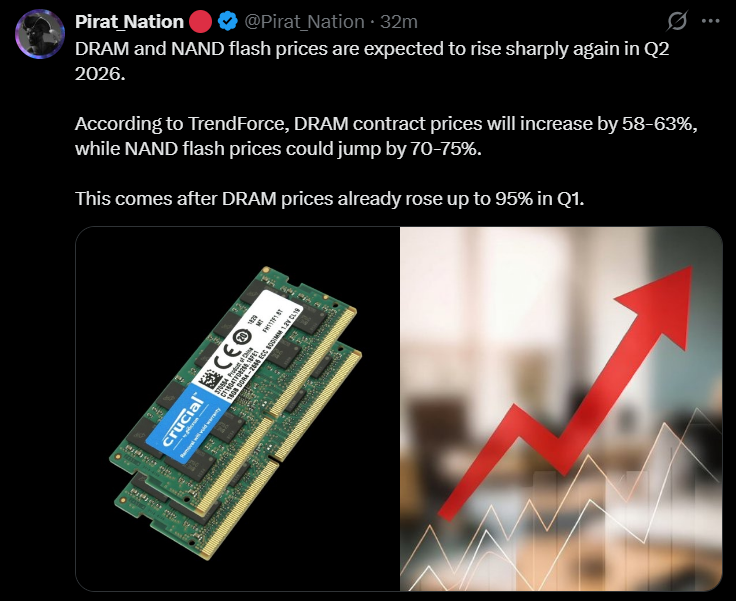
According to the latest memory pricing survey published by TrendForce on April 2, 2026, both DRAM and NAND Flash are about to become dramatically more expensive again. DRAM contract prices are forecast to rise 58% to 63% quarter-over-quarter in Q2 2026; meanwhile NAND Flash contract prices are expected to surge 70% to 75% over the same period. DRAM contracts climbed a record 90% to 95% in Q1 2026 — the steepest single-quarter rise ever recorded. NAND Flash is also accelerating, with its roughly 75% Q2 jump actually outpacing DRAM for the first time in this current price surge cycle.
Discover more
This situation is significant, because this is not a short-term blip. TrendForce describes it as a structural shift in the global memory chip market due to one driven by the AI revolution rather than typical boom-bust cycles. Historically, memory markets corrected themselves within a year or two. This time, analysts say the underlying causes are far more deeply rooted.
Cloud providers like Google, Amazon, Microsoft, and Meta are absorbing enormous quantities of memory chips for their AI infrastructure, locking in supply through multi-year agreements, and leaving the manufacturers with very little to sell to the rest of the market. Now, the result of all this is a global DRAM and NAND Flash shortage.
Why Are DRAM and NAND Flash Prices Rising So Sharply?
TrendForce's global memory market projection for 2026 is a staggering $551.6 billion, with DRAM revenue alone up 144% year-on-year. This might be one of the largest wealth transfers in semiconductor history, driven entirely by AI-driven demand. The problem is that memory manufacturers like Samsung, SK Hynix, and Micron have redirected their most advanced production capacity toward HBM, because AI chip makers pay premium prices for it.
This leaves a smaller capacity for conventional DRAM (DDR4, DDR5, LPDDR5) and for NAND Flash storage. For example, in Q2 2025, SK Hynix already announced that its entire DRAM production allocation for 2026 was sold out, almost a year in advance, sold completely to AI customers. Samsung, Micron, and Kioxia have told similar stories.
Now, compounding this, "Cloud Service Providers" (CSPs) — including "North American" hyperscalers like AWS, Google Cloud, and Microsoft Azure - have adopted extraordinarily aggressive procurement strategies. They have placed open-ended orders with memory suppliers, indicating that they will buy whatever is available at any price.
The DRAM supply-demand imbalance has become so severe that some wholesale suppliers now lock in RAM price quotes for just one hour, because prices change faster than contracts can be finalized. Additionally, on the NAND Flash side, there is an additional layer of pressure. Enterprise SSD demand from AI data centers has grown so strongly that it is displacing supply for consumer-grade SSDs and mobile storage.
Discover more
Kioxia, which is one of the world's largest NAND Flash manufacturers, reportedly disclosed that its entire 2026 NAND production is already sold out to enterprise customers. NAND makers, including Samsung, SK Hynix, Kioxia, and Micron also reportedly scaled back NAND production in the second half of 2025 as part of a coordinated push to lift prices that had hovered near cost price. Samsung reportedly considered hiking its NAND prices by 20–30% or more in negotiations with global clients.
Laptop prices are expected to climb 15–40% across major brands. In the smartphone market, Android brands are being forced to either raise launch prices or downgrade specs — with the low-end smartphone market potentially returning to just 4GB of RAM in new base models for 2026. TrendForce revised global smartphone output forecasts down by 2% and notebook production forecasts down by 2.4% — directly because memory has become unaffordably expensive for manufacturers to include in volume.
When Will DRAM and NAND Flash Prices Finally Drop?
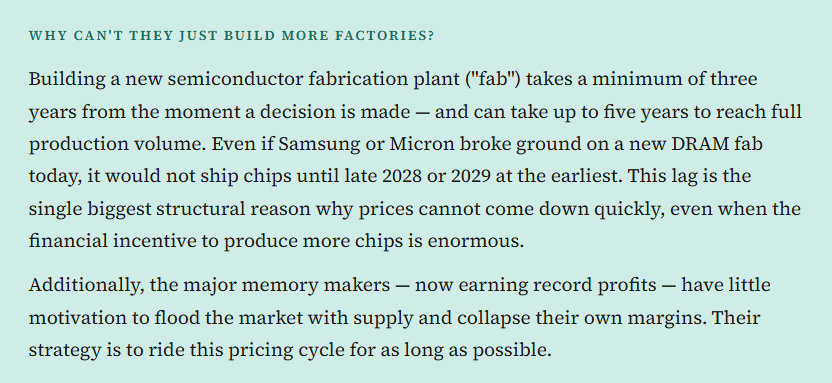
The honest answer that is backed by nearly every major analyst firm covering the memory sector is that the prices will not drop before late 2027, and possibly not until 2028 or even later. TrendForce has stated it expects a pronounced memory shortage throughout all of 2026, with new fab capacity unlikely to come online in meaningful volume before late 2027 or 2028.
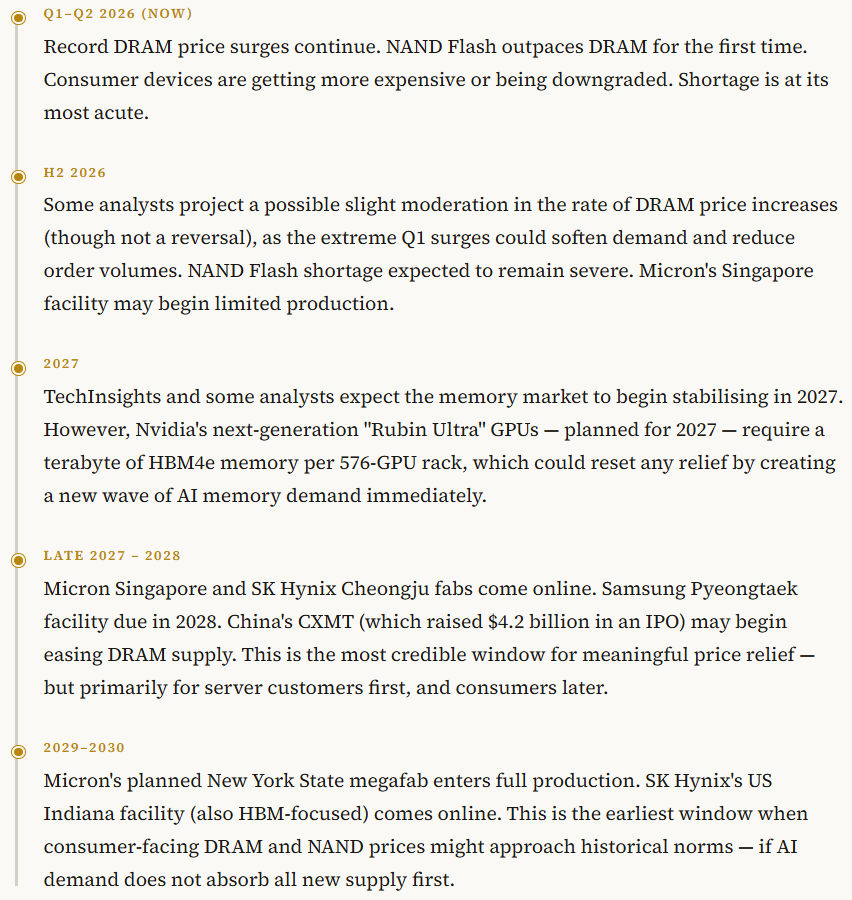
Gartner analyst "Atwal" stated that the prices will "remain high almost through to the end of 2027." "Counterpoint Research" places the earliest inflection point for price relief at Q4 2027. "Intel CEO Lip-Bu Tan," speaking publicly at the 'Cisco AI Summit,' stated, "There's no relief until 2028." The SK Group chairman has publicly warned that the memory chip shortage could last until 2030.
If these reports are true, then it's a problem. Every device that consumes memory components will become more expensive as the time goes by. For everyday consumers, the impact is direct: if you are buying a laptop, SSD, phone, or even a camera in 2026, you are paying substantially more than you would have a year ago, and prices are not done rising yet.
Anyways, what are your thoughts on this current situation in the global memory market? If you think you have some suggestions, then drop them in the comments.