
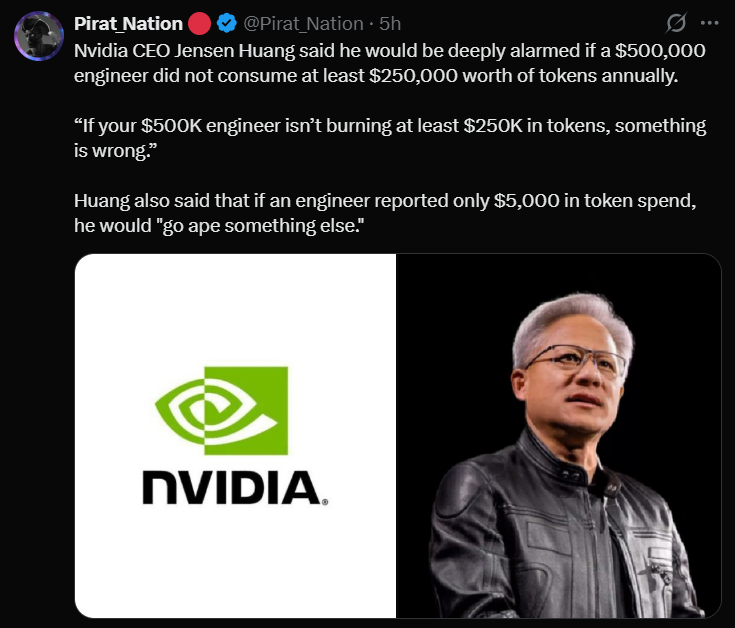
At Nvidia's GPU Technology Conference (GTC 2026) in San Jose on March 16, 2026, Jensen Huang (the CEO of Nvidia) made a statement that immediately went viral. He appeared on the "All-In Podcast," where he was recorded live on the GTC expo floor alongside hosts Chamath Palihapitiya, Jason Calacanis, David Sacks, and David Friedberg. "If that $500,000 engineer did not consume at least $250,000 worth of tokens, I am going to be deeply alarmed," said Jensen Huang.
Further he said, "That $500,000 engineer at the end of the year, I'm going to ask them how much did you spend in tokens?" He was proposing a concrete, measurable yardstick for AI-powered engineer productivity, which is tied directly to dollars spent on AI inference tokens. He also said, "If that person said $5,000, I will go ape something else."
AI Tokens:
In the world of artificial intelligence, a token is the basic unit that an AI model uses to read and generate text, which is roughly equivalent to a fragment of a word. The more an AI thinks, reasons, writes, or codes, the more tokens it consumes. Companies like OpenAI, Anthropic, Google, and Nvidia's partners price AI usage in cost per thousand or million tokens. So when an engineer uses tools like GitHub Copilot, Claude, ChatGPT, Gemini, or even runs automated AI agents to complete complex tasks, every single interaction burns tokens. These tokens cost real money.
Basically, Huang is saying that if there's a $500,000-per-year software engineer at a company like Nvidia, then he/she should be using AI tools so aggressively, so constantly, and so deeply that his/her token consumption alone approaches half of the annual salary in value.
In his vision, a top-tier modern engineer isn't someone who merely uses AI occasionally to autocomplete code. They are someone who orchestrates fleets of AI agents working in parallel to autonomously complete tasks, generate synthetic data, run test pipelines, and build software.
In Huang's framework, burning token is the new measure of engineering ambition. Nvidia is actively planning to give every engineer an annual token budget worth roughly 50% of their base pay, which is effectively adds a six-figure AI compute allocation on top of salary. "I'm going to give them probably half of that on top of it as tokens," he said, "so that they could be amplified 10X."
The $2 billion total token spend that Huang mentioned for Nvidia's entire engineering team wasn't a hypothetical figure. When directly asked if the company is spending that amount, he answered simply, "We're trying to." That number, when you divide it across Nvidia's roughly 30,000+ engineers, lands precisely in the range of the "half of the salary" model he described.
Why Did Jensen Huang Say This?
He described a near future where every Nvidia engineer would oversee not one AI tool, but a team of 100 AI agents operating in parallel. "Work that used to take months can now be done in a couple of days," Huang said. In this world, the traditional metrics of engineering productivity, such as - lines of code written, tickets closed, and features shipped — are no longer sufficient.
Token spend, in Huang's view, is the closest proxy to - how much AI-powered horsepower is this engineer actually deploying. Huang was very deliberate in framing AI token budgets as a competitive recruiting tool. "It is now one of the recruiting tools in Silicon Valley: How many tokens come along with my job?" he said.
Tomasz Tunguz of "Theory Ventures" has described tokens as a potential "fourth component" of tech compensation — alongside salary, bonuses, and equity. Thibault Sottiaux of "OpenAI" has noted that job applicants are increasingly asking about compute access in interviews.
Public Reaction:
Engineers on Threads and Reddit were quick to point out a technical reality, which is at current token pricing, it is almost mathematically impossible for a single human engineer to manually consume $250,000 in tokens per year, even working 18 hours a day, 7 days a week. "Unless token prices increase a lot, I literally cannot burn $250K in tokens," wrote by one engineer on Threads.
However, many AI-forward engineers and investors agreed with Huang's core point and acknowledged that AI agents operating autonomously can realistically generate millions of tokens per day, and companies that restrict engineer access to compute are leaving enormous productivity gains on the table. Andreas Welsch of "Intelligence Briefing" noted that roughly 80–85% of AI projects have failed since 2018, but the ones that succeed are doing exactly what Huang describes.
Goldman Sachs weighed in separately, estimating that AI could automate tasks accounting for 25% of all U.S. work hours, while displacing 6–7% of jobs during the adoption period. A Mercer survey found that 65% of executives expect 11–30% of their workforce to be reskilled due to AI by the year 2026.
Anyways, what is your opinion on these statements made by Jensen Huang? Do you think his techniques can become adaptable or become controversial in future? Let me know all your answers in the comments, where you can also provide the latest news so I can make a breakdown of it.